I imagine you, dear reader, are probably a little tired of reading the updates of my time in SF, so this will be the last post. It is, however, a goody.
As a team building activity – I guess you could call it that – a few of us visited the Science Museum in Mountain View. Museums can be hit or miss, but this was definitely the former.
The exhibition is structured in such a way that you walk through the history of the computer, from 3000 years ago to today.
Now, you must be asking, who the hell had a computer a few hundred years before Christ? Well, the Egyptians and the Chinese, at the very least, they just didn’t call them MacBooks. Instead, they were known as abacuses.
A computer is simply a tool that allows numbers to be calculated, or “computed”. From that, we can do a bunch of things, but it all starts there. Even AI, the modern day wizardry machine, is just a bunch of linear algebra.
An abacus is a surprisingly powerful tool. In fact, with a little bit of experience, it can solve most arithmetic problems only slightly slower than a modern day calculator. But my favourite tool in the early days were the bones.
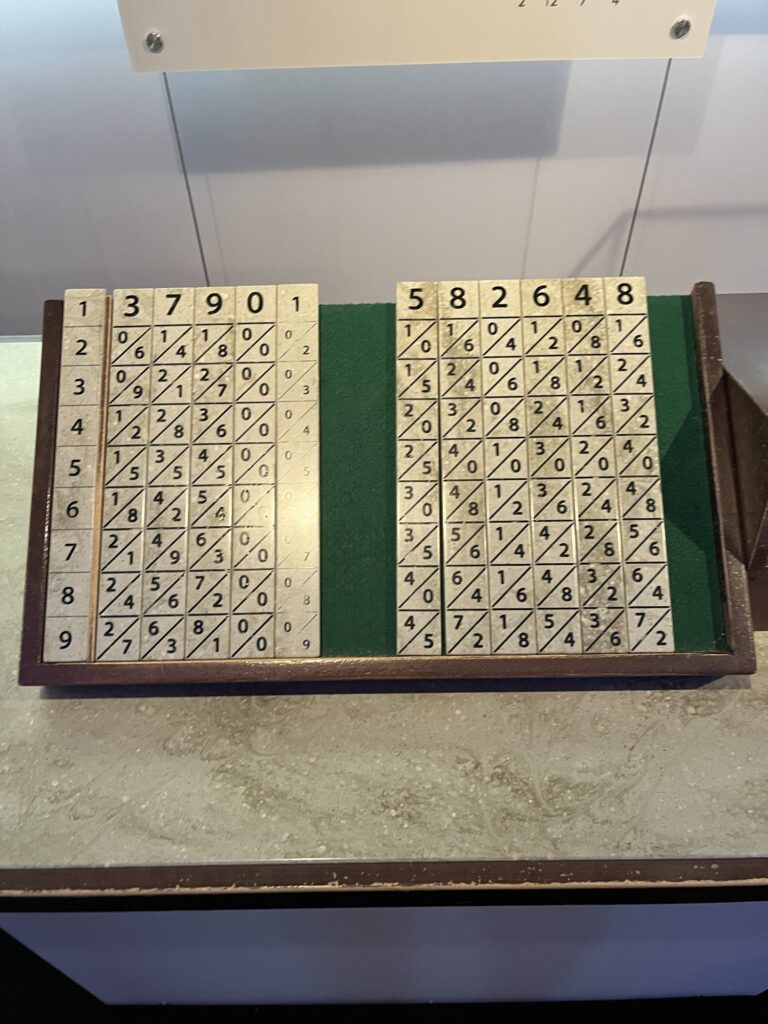
How do you use this tool, you may ask? Well, it’s a simple multiplication and division tool. Just say you want to calculate 37 x 5. You simply find the 3 and the 7 numbers on the X column, and then colocate where they intersect with the 5. Here, you’ll find the numbers 1/53/5. You simply add the numbers together which are within the diagonal lines, and then take the independent numbers on face value. This gives you 1(5+3)5, or 185, which is the exact answer for 37*5. Feel free to trial out different numbers and see what answers you get!
From there, the museum snakes through the very earliest computers, which are huge, cumbersome, and filled with wires, all the way through to robots, mobiles, laptops, supercomputers, and ultimately AI. I would highly recommend anyone in the area to go visit, largely because it answers so many questions that many of us are embarrassed by.
What is the internet? How does it work? What is a computer chip? How does THAT work? How does AI work? How does a camera work? When I shoot the screen on Duck Hunter 3 with a laser gun, how does the computer know where I aimed?
So many questions, and one place that has at least some of the answers.


Leave a Reply to Map man Cancel reply