The World Cup is over. Spain were deserved winners, Argentina were embarrassed for the 120 minutes of the final, and even more so in the 120 seconds afterwards.
As I wrote about HERE, I have been running my own mini-tournament, competing again Nate Silver’s Model and the aggregated betting odds. Here is how we finished:
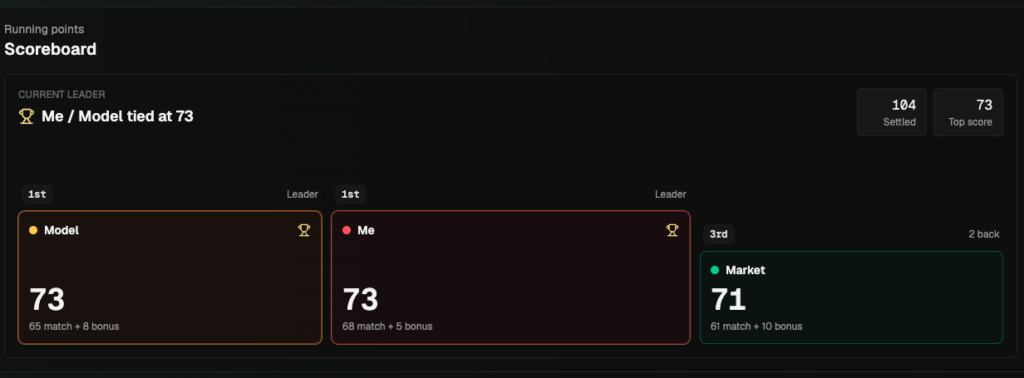
A win, albeit tied, but a win. Pretty happy with that, because at one point it looked a little sketchy.
With a single game to go, I was sitting very pretty, but the Champion bonus points were to be my undoing. I got sucked into the CR7 hype, and picked Portugal as my number one, and let my heart do the talking by picking Australia as my 10th choice. Ultimately, Spain was my 5th choice, hence my five points, compared to the Model getting 8 and the Market correctly picking Spain. Had I not added this final twist, a clean victory would have been mine.
You may be wondering how someone with a relatively rudimentary understanding of world football beat the bookies and a bonafide statistical genius? Two things; structure and luck.
Luck is straight-forward; I got the winner 46 times, 11 of which were the exact score (a 44% hit rate, so 33% better than chance alone. I’ll take that, but the group stages had some pretty easy games to pick, Cabo Verde drawing to Spain notwithstanding.
The main advantage was structural; I got to see what Model and Market had done before I finalized my pick. This turns out to be a HUGE advantage, as I could play strategically. Secondly, there were many cases where the other players’ “leaked” information. For the Market, the rule was that the lowest H2H also decided the exact score pick. For example, if the market said France was going to win, but had 1-1 draw as the most likely score line, the Market HAD to select the result with the lowest odds for a French WIN. This meant that I could use the information from the Market (that a 1-1 draw was going to be likely), and act on it in a way that the market couldn’t.
I was curious if the data had some answers, so I asked Claude to analyse the results. I’ll share their findings tomorrow, very, very interesting.
Leave a Reply